



Updated for 2026
Are you shopping for a new air conditioner in the Toronto area? Don’t worry if you’re unsure where to start; there are so many options that it’s easy to feel overwhelmed.
In 2025, over two-thirds of Canadian households used air conditioning or similar cooling equipment to offset the summer heat, and Ontario households led the country at 83%.
A cool home isn’t a luxury here anymore. It’s simply how we get through a hot, humid Ontario summer. Since 1974, we’ve helped GTA homeowners choose and install the right cooling solution for their space and budget.
This guide walks you through the best air conditioners for a Canadian summer: our top picks for 2026, how central and ductless systems stack up, which brands we trust, and how to size the right unit for your home.
- Best Air Conditioners in 2026
- Top Air Conditioner Brands
- Is Ductless or Central Air Conditioner Better For Your Home?
- What About A Heat Pump?
- Is Energy Efficiency Important To You?
- Do You Want Multiple Cooling Zones?
- What Size Air Conditioner Do I Need For My Home?
- Why You Should Buy A Maintenance Plan
Best Air Conditioners in 2026
Every brand says its air conditioner is “the best”.
To cut through that noise, it helps to compare the top models side by side with what actually matters: efficiency, warranty, and price. Below are four models we sell and install across Toronto and the GTA, each the strongest pick in its category.
One number that comes up a lot when you shop is the “SEER2”, which rates how efficiently an air conditioner cools over a full season.
It’s the current version of the older SEER rating, and with both, a higher number generally means lower electricity use for the same cooling and thus, lower running costs.
| Recommendation | Name | Type | AC Costs | Efficiency (SEER2) | Warranty |
| Best Overall | Carrier Infinity (26VNA1) | Central, variable-speed | $$$ | up to 21 | 10-yr parts or 5-yr parts with 3-yr labour (Consumer Choice, with registration) |
| Best Budget | Lennox Merit (ML17KC2) | Central, two-stage | $ | up to 18 | 10-yr parts (with registration; 5-yr base) |
| Best Energy-Efficient | Lennox Signature (SL25KCV) | Central, variable-capacity | $$$ | up to 26 | 10-yr parts and compressor |
| Best Ductless | Carrier (40MPHB) | Ductless mini-split, single-zone | $$ | Varies by pairing (ENERGY STAR) | 10-yr parts (with registration) |
Best Overall Air Conditioner: Carrier Infinity (26VNA1)
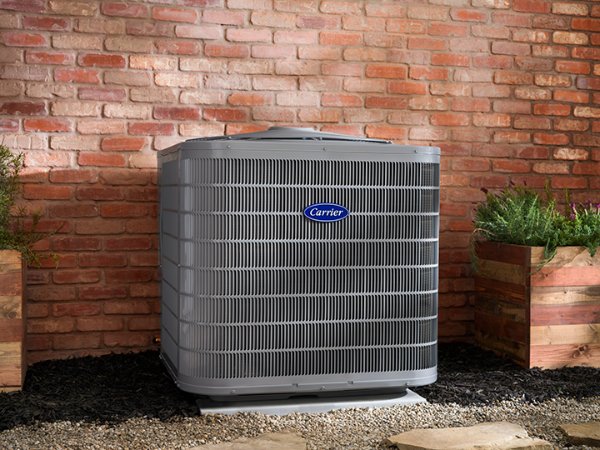
If you want the best all-around balance of comfort, efficiency, and quiet, the Carrier Infinity is our top pick.
Its variable-speed compressor runs anywhere from 25 to 100% capacity, so instead of blasting on and off, it makes small adjustments to hold a steady, even temperature.
That same variable-speed operation is excellent at removing moisture from the air, which is exactly what you want in a humid GTA summer. You get up to 21 SEER2, sound levels as low as 55 decibels, Carrier’s Greenspeed intelligence, the newer lower-emission R-454B refrigerant, and ENERGY STAR certification.
Add the Consumer Choice Warranty and Carrier’s SmartHome app control, and it’s a premium unit that earns its place.
Best Budget Air Conditioner: Lennox Merit (ML17KC2)
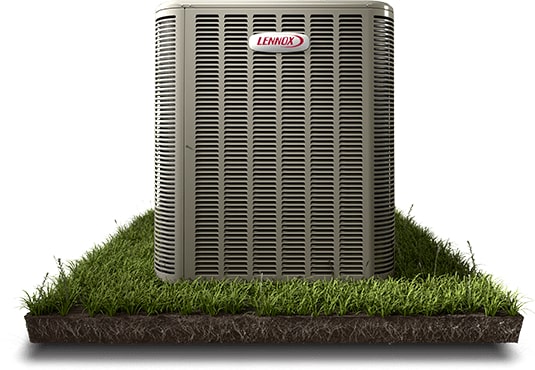
The Lennox Merit is the practical, wallet-friendly way into reliable central cooling.
It uses a two-stage compressor, so it can run at a lower setting most of the time and only ramp up on the hottest days, balancing comfort against your energy bill. You get up to 18 SEER2, ENERGY STAR certification, the 2025-compliant R-454B refrigerant, and a Quantum coil built to stand up to our weather.
That said, budget units run louder than premium ones. The Merit can be as low as 73 decibels, louder than the whisper-quiet range of the top tier. If value and dependable cooling matter more than the quietest possible operation, this is a smart buy.
Best Energy-Efficient Air Conditioner: Lennox Signature (SL25KCV)

When lowest running costs are the goal, the Lennox Signature is the efficiency leader on this list at up to 26 SEER2, one of the highest ratings you can buy.
Its variable-capacity compressor with Precise Comfort technology fine-tunes cooling in tiny increments, keeping temperatures rock-steady, sipping energy, and quietly managing humidity through the muggiest weeks of summer.
It runs as low as 58 decibels, carries ENERGY STAR certification and the R-454B refrigerant, and is backed by a 10-year limited warranty on the compressor and covered components.
If you plan to stay in your home for years, the higher upfront cost tends to pay you back in lower monthly bills.
Best Ductless Air Conditioner: Carrier (40MPHB)
No ductwork? No problem.
The Carrier 40MPHB is a single-zone ductless mini-split that cools a specific room or area without any ducts at all, which makes it ideal for additions, finished basements, condos, sunrooms, or that one space your central system never quite reaches.
It’s remarkably quiet (as low as 29 decibels), ENERGY STAR certified, and comes with a built-in humidity sensor and an occupancy sensor that aims airflow toward or away from where people actually are.
With Wi-Fi on applicable configurations, it’s covered by a 10-year parts warranty with registration. Its exact SEER2 depends on the outdoor unit it’s paired with, so this is one where a quick chat with us pins down the right match.
See more Carrier Ductless options if this is the route for your home.
Top Air Conditioner Brands
Carrier and Lennox are the two brands we install most often, and both make excellent air conditioners.
The differences show up at the edges: top-end efficiency, how quietly they run, and where each brand’s sweet spot sits on the price scale. Here’s a side-by-side look at the models we featured above.
| Feature | Carrier | Lennox |
| Top Efficiency (SEER2) | up to 21 (Infinity 26VNA1) | up to 26 (Signature SL25KCV) |
| Budget Range | Mid-range to premium | Low-cost to premium |
| Ideal Homeowner | Wants strong humidity control and smart-home features | Wants class-leading efficiency, or a budget-friendly entry |
| Warranty | 10-yr parts (Consumer Choice, with registration) | 10-yr parts and compressor (Signature); 5 to 10-yr (Merit) |
| Sound (dB) | as low as 55 | as low as 58 |
| Variable Speed? | Yes (Infinity) | Yes (Signature) |
Pro tip: A variable-speed or variable-capacity compressor doesn’t just save energy; it runs longer at low speed, which removes far more humidity from the air than a basic single-stage unit. In an Ontario summer, where the humidity is just as much a problem as the heat, that’s the difference between “cold but clammy” and genuinely comfortable.
Carrier
Recognized as one of the founding names of modern air conditioning, Carrier pairs excellent humidity control with a strong smart-home ecosystem. Its Infinity line brings variable-speed comfort, Greenspeed intelligence, and app-based control, which makes it a great fit if you want a quiet, precise, connected system. Browse our full range of Carrier air conditioners to see the options we install.
Lennox
Lennox is the efficiency leader of the two, with its Signature series reaching up to 26 SEER2, one of the highest ratings available anywhere. It also spans the widest price range, from the value-focused Merit tier up to the premium Signature line, so there’s a Lennox for most budgets. Take a look at our Lennox air conditioners to compare tiers.
Is Ductless or Central Air Conditioner Better For Your Home?
Ductless and central air conditioners both work by alternately evaporating and compressing a refrigerant to produce cool air.
However, central air usually consists of a large outdoor compressor unit and indoor air handler(s), circulating cooled air through the same ducts your furnace uses.
Ductless air conditioners consist of a smaller compressor unit (usually mounted on an exterior wall) and one or more wall-mounted air handlers in the area(s) to be cooled. They do not require ductwork.
Choosing which type of air conditioner is best is a very personal decision, based on your home and your cooling preferences. Central air conditioning and ductless units each have areas where they shine and others where they’re not so strong.
Cooling
Even if you have a large home, central air conditioning can provide cooling throughout.
While many ductless air conditioners (single-zone units) are designed to cool only 1 room, multi-zone units can cool multiple rooms with different temperatures for each zone.
Retrofitting
Central air is fine for retrofitting if you already have ductwork in place for a forced-air furnace, or if you have enough space in your attic or basement to install new ducts.
However, ductless systems are simple to retrofit just about anywhere and are also an excellent way to install air conditioning in new additions to your house.
Pro tip: Are you about to install central AC? Have your old ductwork cleaned and repaired first; you’ll increase efficiency and decrease airborne contaminants like dust and mould in your home.
Noise
A central air conditioner’s outdoor compressor unit can be on the noisy side. Ductless air conditioners are much quieter.
Appearance
Central air conditioning is less visible in your living area.
The indoor air handler is down in the basement with your furnace, and the compressor is outdoors (where you can hide it with a fence or plantings, while still allowing room for airflow and access for HVAC techs).
Ductless AC is more obvious, although some designers integrate it cleverly into the room décor.
If you decide a central air conditioner is best for you, you’ll want to make sure you know how to landscape around your new AC unit.
Cost
The cost to buy central air conditioning is usually lower. Ductless AC is more expensive to purchase, but you save on both the fast, simple installation and the ongoing energy costs to operate this system.
What About A Heat Pump?
A heat pump is a great option when you’d like a ductless system that combines both heating and cooling.
However, heat pumps start losing heating efficiency when the outdoor temperature is below 4° Celsius. In our chilly Canadian climate, they are best used as an energy-saving supplement to another home-heating method, such as a gas furnace.
For Canadian-approved units, check out our best cold climate heat pumps guide.
Is Energy Efficiency Important To You?
A central air conditioner system is less energy-efficient than a ductless air conditioner.
The good news is that air conditioning technology has advanced enormously over the past decade, creating central AC that is much more energy-efficient than it was 10 or 20 years ago. Look for an Energy Star certified central system.
Ductless air conditioners are the clear winner in terms of energy efficiency for 3 reasons:
- Efficient use of electricity
- Efficient circulation of cooled air
- No leakage, as there would be with ductwork (ductwork can leak up to 30% of your cooled air)
Do You Want Multiple Cooling Zones?
“Zoning” your AC lets you set different temperatures and independent cooling schedules for different areas of your house.
To zone a central air conditioner system, you will have to modify your existing ductwork. This involves installing dampers to create different temperature zones.
Ductless is usually more convenient if you’d like to zone your cooling. All you’ll need to do is connect several indoor air handlers to your outdoor compressor unit.
What Size Air Conditioner Do I Need For My Home?
Correct sizing is one of the most vital steps in choosing the right central air conditioner for your home.
To determine the right size, a general rule of thumb is that you will need 20 British Thermal Units (BTU) of cooling per square foot. You’ll also need to consider:
- Layout of your existing ductwork.
- Amount and quality of home insulation.
- Climate conditions. In the Greater Toronto Area, summers tend to be very hot and unpleasantly humid, so you’ll want AC that can properly dehumidify your home. The “micro-climate” of your house also makes a difference; a home with many west- or south-facing windows will get hotter than one with just a few windows, facing north or east.
- Landscaping. If you have many mature trees surrounding your home, they will shelter the building from strong sun or wind. This also affects your cooling needs.
Why You Should Buy A Maintenance Plan
With a Husky HVAC maintenance plan, you have peace of mind. You’ll know that our expert team will inspect and tune up your heating and cooling system every year.
Regular professional maintenance will help your system perform at peak efficiency, saving you money on energy costs. It also means your air conditioner is much less likely to break down during one of those heavy-duty Vaughan heat waves.
Our maintenance plan can even extend your AC’s working life! But don’t just take our word for it. Check out this great Google Review of our service:
Husky installed our air conditioner in 2009, and we were delighted with their services and quality work. The staff was patient and understanding to answer our questions and provided the best recommendation for our purchase. Since then, Husky is our go-to company when we had any issues with heating and cooling. The staff who answered my calls was super helpful for scheduling a timely appointment and the technician always came on time to fix the problem to our satisfaction. I am very impressed by their technician Dave for his professionalism, expertise and superb customer care.
- Raymond L.
Husky – The Reliable Source For Your New Air Conditioner
Whichever type and size of air conditioner you need, turn to Husky. You’ll get expert answers to all your AC questions.
We’re full-service air conditioning professionals in Vaughan, providing sales, service, and maintenance plans across Toronto.
I WANT A QUOTE ON THE BEST AC FOR MY HOME